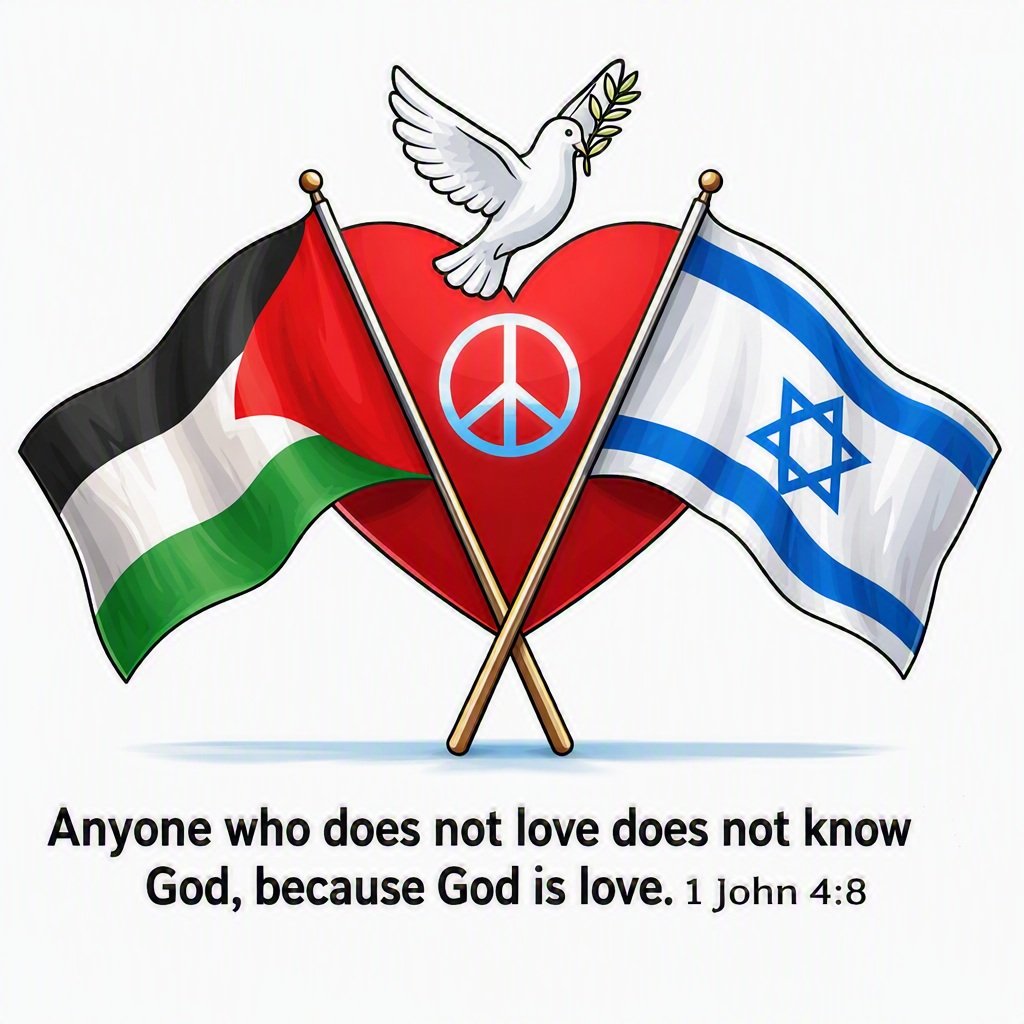
This has been a tough subject for me to write about as it has many facets to it. As I continue to reflect on the Israel–Palestine conflict, I find myself guided not by politics, but by a basic human conscience — the shared moral instinct that tells us when something is deeply wrong. In the beginning, I have to admit I was naive, even complicit, simply because I did not understand the depth of suffering unfolding before my eyes. But now my eyes are open. And I cannot begin to express the heartbreak I feel after seeing a father carrying his child whose head was partially destroyed by a bomb attack. That image haunts me. It breaks my heart. It has forced me to confront the reality of what is happening, and it has awakened a responsibility within me that I can no longer ignore.
The endless war, the killing of civilians — babies, women, families — and the destruction of entire communities weighs heavily on my spirit. After listening, learning, and witnessing the human cost, I cannot support the ongoing violence or the policies that enable it. As a Christian, my faith calls me to defend the vulnerable and to stand against injustice — but these values are not mine alone. They are shared by people of all beliefs: religious, secular, humanist, and atheist. We all understand that human life is precious, and that no ideology should justify domination or the erasure of another people.
This does not mean rejecting the Jewish people. In fact, I stand with the many Jewish individuals who are courageously anti‑Zionist, who oppose the occupation, and who insist that their identity and ethics must never be used to justify injustice. My concern is not with Judaism, but with a political ideology that has caused immense suffering for Palestinians and has distorted the moral witness of the region.
Part of this suffering includes the growing mistreatment of Christians in Jerusalem. Church leaders have repeatedly warned that extremist groups — not the Jewish people as a whole — are harassing clergy, vandalizing churches, spitting on priests, and attempting to intimidate Christian communities. This is not Judaism; it is religious nationalism. It stands in opposition to the values of justice, compassion, and human dignity that people of all beliefs hold dear. We cannot remain silent when our neighbors — including Christian Palestinians, who have lived and worshipped there since the earliest days of the region’s history — are threatened, marginalized, or pushed out of the city where their communities have existed for centuries.
We must also acknowledge the suffering of Muslim Palestinians, who endure the same violence, displacement, and loss. Solidarity is not limited by religion or worldview; it is shaped by our shared humanity and our recognition that every person deserves safety, dignity, and freedom.
And we must speak honestly about the brutality that has unfolded. One of the most devastating examples was the Palestinian farmer who was abducted by extremist settlers, blindfolded, tortured, and ultimately killed — while soldiers stood by and blocked aid from reaching him. His death was not just a tragedy; it was a moral outrage. It was a violation of human dignity so severe that it shook the conscience of people around the world. His story, like the father carrying his wounded child, is a reminder that behind every statistic is a human life — a family, a community, a person who mattered.
At the same time, many Americans are beginning to question the role of the United States in this conflict. Polls and public statements show a growing number of U.S. taxpayers who want their representatives to cut off or significantly reduce military funding and weapons transfers to Israel, especially in light of the humanitarian crisis in Gaza. People across the political spectrum are asking whether billions of dollars in weapons — paid for by American citizens — should continue flowing into a conflict where civilians are suffering at catastrophic levels.
This concern has grown even stronger as the United States has become increasingly entangled in conflict with Iran. Many analysts, diplomats, and former officials have noted that Israel’s long‑standing campaign against Iran’s nuclear program — including covert operations, targeted strikes, and pressure on U.S. policymakers — has significantly shaped American policy. Israel has consistently urged the United States to confront Iran militarily, and several escalations in recent years have followed Israeli actions or intelligence assessments. While the United States makes its own decisions, it is clear that Israel’s strategic priorities have influenced the path toward confrontation. We must be willing to name these dynamics honestly and call for restraint, diplomacy, and a foreign policy rooted in justice rather than perpetual conflict.
This awakening is not happening only in the United States. Europe is experiencing a profound shift in public opinion toward Israel, driven by the scale of destruction in Gaza and the regional escalation involving Iran. Recent YouGov and Pew data show that net favorability toward Israel has fallen to historic lows across Western Europe, with unfavorable views dominating in Germany, France, Spain, Italy, Denmark, and the United Kingdom.
And here in Belgium, the shift is especially clear. Belgian polling consistently shows strong public disapproval of Israel’s military actions in Gaza. Belgian citizens — across linguistic, cultural, and political lines — express deep concern about civilian casualties, human rights violations, and the humanitarian crisis. Belgium has been one of the most outspoken EU countries calling for accountability, with large public demonstrations in Brussels, Antwerp, and Liège demanding a ceasefire and urging the Belgian government to take a firmer stance on human rights. Belgian public opinion reflects a moral clarity that aligns with the broader European trend: a desire for peace, justice, and an end to the suffering of innocent people.
Public pressure in Europe has become so strong that over one million citizens signed a petition demanding the suspension of the EU–Israel Association Agreement, forcing EU leaders to debate the issue formally. Spain, Ireland, and Slovenia pushed for a review, citing human rights violations, while Germany and Italy blocked the move — revealing a widening divide between European governments and their citizens.
Even official EU rhetoric has shifted dramatically. A study of 24,000 EU diplomatic statements found that negative statements about Israel rose from 29% before October 2023 to nearly 46% afterward, a 60% increase. Positive statements fell to just 8%.
Europe’s moral and political landscape is changing. The suffering of Palestinians — Christian and Muslim — has become impossible to ignore. And the public is demanding accountability.
Closing Reflection
In moments like these, when the world feels fractured and heavy, it is easy to lose hope. Yet the very act of caring — of allowing ourselves to feel heartbreak, to question what we once accepted, and to speak out against injustice — is a sign of our shared humanity. Whether we come from faith traditions, secular philosophies, or no belief system at all, we are united by something deeper: the conviction that every human life has value, and that suffering should never be ignored.
We may not all agree on every political detail, but we can agree on this: no child should die in their parent’s arms; no family should be displaced; no community should live in fear; and no person should be stripped of their dignity. Justice, peace, and truth are not the property of any one religion — they are the moral inheritance of all humankind.
As a Christian, I hold onto the belief that light can still break through even the darkest moments, and that love — real, courageous love — has the power to heal what violence has shattered. But I also know that this hope is not mine alone. It is shared by people of many beliefs and by those who do not identify with any faith at all. Love, compassion, and justice are universal languages.
So I offer this closing not as a boundary, but as an invitation:
May we be people who choose compassion over indifference. May we be people who defend the vulnerable and speak truth with courage. May we be people who refuse to let hatred define our future. And may we walk together — Christian, Muslim, Jewish, secular, atheist, and all others — toward a world where justice is real, peace is possible, and every human life is honored.
With hope,
Michael