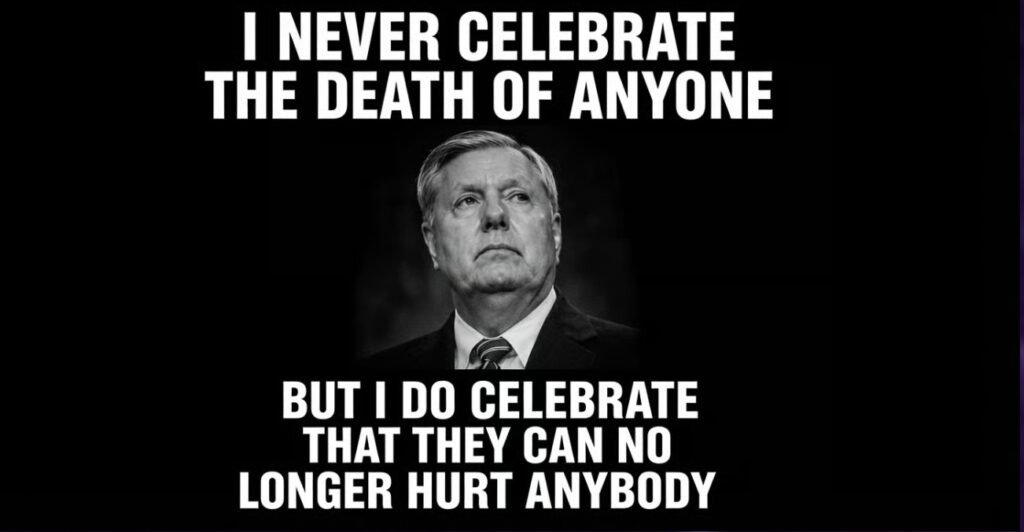
The Shadow of a Senator
Lindsey Graham’s political career is a study in contradictions so stark they border on the grotesque. For decades, he positioned himself as a “principled conservative,” only to become one of the most shameless flip floppers, war hawks, and Trump enablers in modern American politics. His legacy is not one of courage or conviction — but of opportunism, fear, and a willingness to sacrifice human dignity for political survival.
Graham leaves behind a trail of decisions that harmed vulnerable communities, destabilized foreign policy, and undermined democratic norms. And for LGBTQ+ Americans, especially those of us who lived in South Carolina watched him, his record is not just disappointing. It is devastating.
The Flip Flop Phenomenon
Few politicians have reversed themselves as dramatically as Lindsey Graham. He went from calling Donald Trump “a race baiting, xenophobic bigot” to becoming one of Trump’s most loyal defenders is a transformation so abrupt it stunned even his Republican colleagues.
This wasn’t ideological evolution. It was political self preservation.
Graham’s career became defined by:
- Abandoning long held positions when they became inconvenient
- Reinventing himself to match the mood of the Republican base
- Trading integrity for proximity to power
His flip flops weren’t just embarrassing. They were dangerous.
Patronage, Loyalty, and the Appearance of Nepotism
While Graham did not engage in formal nepotism, his political machine operated like a loyalty based patronage network. Access, influence, and opportunity flowed not through merit or transparency, but through allegiance, to Graham himself, to defense contractors, and eventually to Donald Trump.
His inner circle was small, insular, and fiercely protected. His alliances rewarded insiders and punished dissent. His political behavior resembled nepotism in everything but bloodline.
This is the ecosystem he built, and it shaped every policy he touched.
Lindsey Graham & the Iran Conflict — A Career Built on Hawkishness
Graham’s foreign policy legacy is defined by a near obsession with military confrontation, especially with Iran.
He repeatedly:
- Called for pre emptive airstrikes on Iranian nuclear facilities
- Encouraged Trump to respond to provocations with force, not diplomacy
- Supported the withdrawal from the Iran nuclear deal (JCPOA)
- Advocated for direct strikes inside Iran, not just against proxy militias
His rhetoric consistently escalated tensions, framing war as inevitable and diplomacy as weakness. This wasn’t strategy, it was ideological aggression.
Graham’s hawkishness aligned perfectly with defense industry donors who benefited from perpetual conflict. It was politics masquerading as patriotism.
Lindsey Graham & the Israel–Palestine Conflict — Unconditional Support, Zero Accountability
Graham was one of the most unwavering pro Israel voices in the Senate — not in the sense of supporting peace or stability, but in endorsing every military action, every escalation, and every hardline policy, regardless of humanitarian cost.
He:
- Supported Israeli airstrikes and ground operations even during periods of high civilian casualties
- Opposed ceasefires he believed would “reward Hamas”
- Backed billions in military aid without conditions
- Rejected Palestinian statehood efforts
- Supported Trump’s most controversial Middle East decisions, including the embassy move to Jerusalem
Graham’s approach was not diplomacy. It was absolutism — a worldview where one side is always right, and the other is always disposable.
This stance contributed to a foreign policy environment where peace was sidelined, human rights were minimized, and conflict was normalized.
Lindsey Graham’s Record on LGBTQ+ Rights — A Legacy of Harm
For LGBTQ+ Americans, Graham’s political record is not ambiguous. It is openly hostile.
Across his career, Graham:
- Opposed marriage equality
- Supported constitutional amendments to ban same sex marriage
- Backed judges who were openly anti LGBTQ+
- Opposed protections for LGBTQ+ workers
- Supported policies that allowed discrimination under the guise of “religious freedom”
- Repeatedly aligned with the most anti LGBTQ+ factions of the Republican Party
He positioned himself as a defender of “traditional values,” even as he supported policies that stripped LGBTQ+ people of dignity, safety, and equality.
And the hypocrisy was glaring.
For years, rumors circulated about Graham’s own sexuality, rumors he never addressed directly. No one has the right to speculate about a person’s identity. But what is fair to say is this:
If Lindsey Graham was a closeted gay man, his political choices harmed the very community he would have belonged to.
If he was straight, he still chose to weaponize LGBTQ+ rights for political gain.
Either way, the result was the same: LGBTQ+ Americans suffered because of his votes.
Legacy — What He Leaves Behind
Lindsey Graham’s legacy is not one of leadership. It is one of:
- Political cowardice
- Opportunistic alliances
- Harmful foreign policy escalation
- Hostility toward LGBTQ+ rights
- Enabling extremism
- Abandoning principles for power
He leaves behind a Senate seat that will shape South Carolina’s future, and a record that will be debated for years.
But one truth is clear:
Graham consistently chose power over people. And vulnerable communities paid the price.
Closing — A Call for Better Leadership
As we reflect on Graham’s career, South Carolinian’s must demand better from those who seek to lead. Better integrity. Better courage. Better compassion. Better commitment to human rights.
Leadership is not about survival. It is about service.
And Lindsey Graham, for all his years in office, never learned that lesson.