Confronting Apartheid, Racism, and the Machinery of Hate, and Fear.
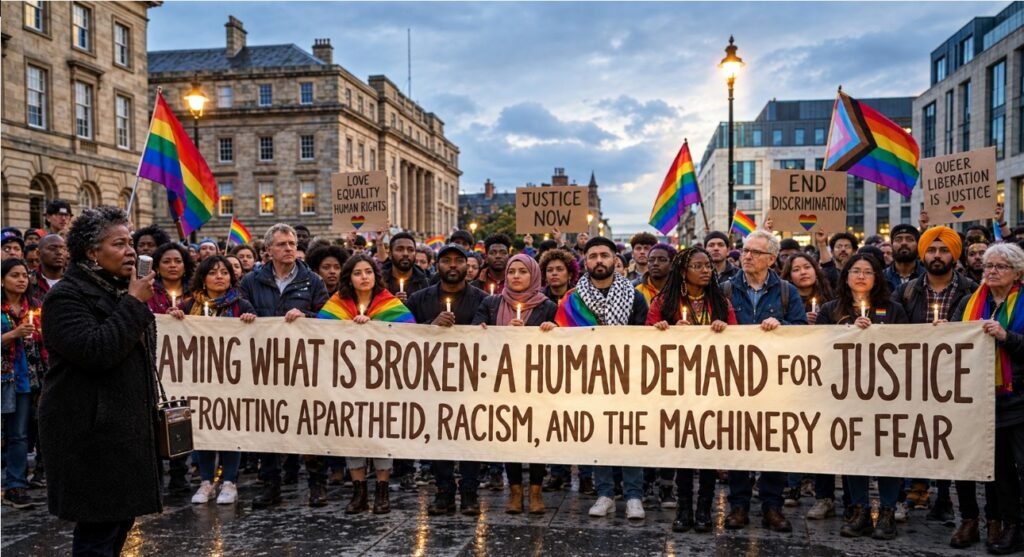
Why the Word “Apartheid” Matters Today
I recently became curious about the term “apartheid state.” I first heard it when Jewish voices around the world were speaking with courage and conviction about how Israel has become an apartheid state. Their willingness to name injustice stirred something in me.
Before going further, it’s important to distinguish between two terms that sound similar but mean very different things:
- Apostate refers to a person (or sometimes a community) that has abandoned or renounced a religious belief or tradition. It is a theological or spiritual term.
- Apartheid refers to a system of legally enforced racial segregation, oppression, and inequality. It is political, structural, and rooted in dehumanization.
One describes belief, the other describes oppression — and they should never be confused.
If you ask anyone from South Africa, they will tell you plainly what apartheid means — because they lived it. Under Nelson Mandela’s era, the term described a system built on separation, inequality, and the deliberate dehumanization of entire communities. It was not just a political structure; it was a wound carried in the soul of a nation.
Racism Is More Than Black and White — It Is Cultural
Learning about apartheid led me to reflect more deeply on racism itself. Too often, especially in American conversations, racism is reduced to black and white. But racism is also cultural — rooted in language, religion, heritage, customs, and identity.
Cultural racism says, “Your way of being is inferior. Your story does not belong here.” It is quieter than biological racism, but just as destructive. It fractures communities, distorts truth, and teaches people to fear what they do not understand.
Values — Spiritual, Human, and Universal
My own values — shaped by my life experience, my relationships, and yes, my Episcopal tradition in the Baptismal vows we renew once a year — call me to honor the dignity of every human being and to strive for justice and peace. But these values are not exclusive to any religion.
They are shared by Humanists, Atheists, Agnostics, and people across every worldview who believe in compassion, fairness, and the inherent worth of every person. Justice, dignity, and truth are not just spiritual or religious concepts; they are human ones.
Belgium Expanded My Understanding of Racism
When I moved to Belgium and married my spouse, my understanding of racism expanded in ways I never expected. Belgium is deeply multicultural, shaped by three official language groups — Flemish‑Dutch, French, and German — each with its own history, identity, and cultural pride. And beyond these communities, Belgium is home to migrants from all over the world: Turkish, Moroccan, South African, Congolese, Eastern European, Middle Eastern, and many others.
Living in this environment opened my eyes to how racism and cultural prejudice operate in complex, layered ways. Here, discrimination is not only about skin color — it can be about language, accent, region, religion, or simply being “from somewhere else.” I saw how cultural identity can become a dividing line, how stereotypes travel across borders, and how people can be marginalized not for how they look, but for how they speak or where their grandparents came from.
My perspective widened, and I realized how narrow my earlier understanding had been. Racism is not one thing — it is many things, all rooted in the same poison.
Naming Harm Without Competing Over It
I denounce racism in every form, just as I denounce homophobia and hate — harms I have personally endured. All these forces I have named in this newsletter are rooted in hatred and fear.
And too often, especially in American discourse, people fall into a competition of suffering: my oppression is worse than yours, my pain matters more than yours.
But suffering is not a contest. Harm is harm. Injustice is injustice.
And yes — Black Lives Matter. Affirming that truth does not diminish anyone else’s worth; it strengthens our collective commitment to justice.
Standing With Those Who Speak Truth
I am proud to stand with Jewish people around the world who denounce Israel as an apartheid state, and I too am a seeker of justice, peace, and wisdom.
Solidarity is not about choosing sides; it is about choosing humanity. It is about standing with those who dare to speak truth, even when that truth is uncomfortable.
Justice, Compassion, and Truth Are Non‑Negotiable
Understanding apartheid, cultural racism, and the many forms of discrimination helps us see how societies lose their way — and how they can find their way back.
Justice is not optional. Compassion is not optional. Truth is not optional.
These are the pillars that keep a society from becoming spiritually and morally bankrupt. When we abandon justice, we abandon our humanity; when we abandon compassion, we abandon our neighbor; when we abandon truth, we abandon our own soul.
Call to Action — For All People of Conscience
This moment in history demands more from us than polite concern. It demands courage. It demands clarity. It demands that we refuse silence when silence becomes complicity.
Whether you are Christian, Humanist, Atheist, Agnostic, Jewish, Muslim, spiritual‑but‑not‑religious, or simply someone who believes in human dignity — you are needed.
We must confront injustice wherever it rises. We must challenge systems built on fear. We must refuse the narratives that divide us. We must build communities where dignity is not a privilege, but a birthright.
Justice is not the work of the few — it is the responsibility of all of us. And the time to act is now.
Editor’s Note
This issue speaks directly to the urgent moral challenges of our time. It invites readers of every worldview — religious, secular, spiritual, humanist — to confront injustice with clarity and courage. The reflections offered here are not abstract ideas; they are lived experiences shaped by community, identity, and the responsibility we share as human beings. May these words stir your conscience and strengthen your resolve.