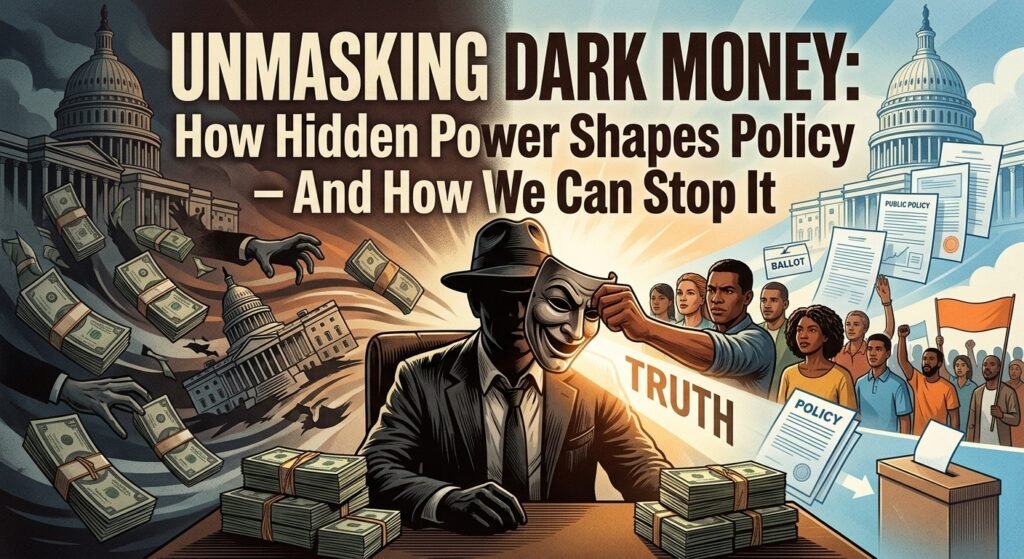
In recent years, many people across the political spectrum have grown increasingly concerned about the influence of dark money in American politics — funds that flow through super PACs, opaque nonprofits, and powerful lobbying groups such as AIPAC, Americans for Prosperity, and others. These organizations can spend enormous sums to shape elections, legislation, and public opinion, often without voters knowing who is behind the money. (Please make sure you check with trusted sources )
This isn’t about left or right. It’s about transparency, accountability, and the health of democracy itself.
What Is “Dark Money”?
Dark money refers to political spending where the original donors are hidden. These funds often move through:
- 501(c)(4) “social welfare” organizations
- Super PACs
- Donor‑advised funds
- Political nonprofits that aren’t required to disclose contributors
The result is a system where wealthy donors and special interests can exert outsized influence, while ordinary citizens are left in the dark.
Why It Matters
Dark money can:
- Distort elections
- Pressure lawmakers
- Undermine public trust
- Drown out the voices of everyday people
- Push policies that benefit a few rather than the many
When voters don’t know who is funding political messaging, they cannot fully evaluate the motives behind it.
AIPAC and Other Major Players
AIPAC is one of the most discussed examples in current public debate. According to multiple watchdog organizations and investigative reporting, AIPAC and its affiliated super PACs are major influencers of U.S. policy toward the Israeli government, directing substantial financial resources toward candidates who support Israel’s strategic and military priorities.
This influence is legal — but largely opaque, because much of the spending flows through super PACs and political nonprofits that do not disclose their donors.
Other organizations — across the political spectrum — use similar structures. The concern isn’t about any single group. It’s about the system that allows massive, untraceable financial influence.
Netanyahu’s On‑Camera Admission
In addition to the role of dark‑money groups, we are now seeing world leaders openly acknowledge their influence over U.S. policy. In a recent televised interview, Israeli Prime Minister Benjamin Netanyahu boasted on camera that his decades of media presence in the United States — “nearly a thousand hours on American television,” as he described it — helped push Washington toward attacking Iran.
His remarks suggested that his personal influence and messaging campaign contributed to the U.S. joining Israel in military action. Iranian officials quickly seized on the comments, accusing him of manipulating Washington into war.
This is not speculation — it is based on Netanyahu’s own recorded statements, which have been widely circulated and reported by multiple outlets.
This raises serious questions about how foreign lobbying, political spending, and personal influence intersect with American decision‑making on war and foreign policy.
What Can We Do? Practical Solutions
Here are several reforms widely discussed by experts and advocates:
1. Strengthen Disclosure Laws
Require all political organizations to disclose donors above a certain threshold. Transparency is the foundation of trust.
2. Ban or Limit Super PACs
Many reformers argue that unlimited outside spending is incompatible with a healthy democracy.
3. Public Financing of Elections
Small‑donor matching systems (like those used in New York City) amplify the voices of ordinary citizens.
4. Overturn or Limit Citizens United
This Supreme Court decision opened the door to unlimited corporate and nonprofit spending. Many legal scholars believe revisiting it is essential.
5. Close Nonprofit Loopholes
501(c)(4) groups should not be allowed to function as shadow political operations.
6. Encourage Voter Education
The more people understand how dark money works, the harder it becomes for it to operate unnoticed.
A Hopeful Note
Even though the system feels overwhelming, change is possible. States and cities across the U.S. have already passed strong transparency laws, created public financing systems, and pushed back against dark‑money networks. Reform is not theoretical — it’s happening.
As human beings, we share a responsibility to seek justice, truth, and the common good. Bringing light into the places where power hides is part of how we protect one another and strengthen our democracy.